Abstract
This paper investigates the correlation between the issuance of airframe and powerplant mechanic certificates and revenue passenger miles (RPM) flown by domestic U.S. airlines. It is theorized that the airlines are the main factor driving the employment is this field. Although there is a lead/lag effect, an increase in RPM can be an indicator of increased economic activity, and employment opportunities for individuals who are willing to invest the time and enter the career field of aircraft maintenance. The data analyzed is from 2004 to 2019 with the recent pandemic excluded to prevent skewing of the results. Yearly totals are used for both mechanic certificates and RPM. The information is obtained from the Federal Aviation Administration (FAA) and the Bureau of Transportation Statistics (BTS). A paired t-test is used to correlate the relationship of RPM and mechanics certificates issued by the FAA. The results indicated that there is a strong correlation between the issuance of original A&P certificates and the RPM flown by domestic airlines. These results could be significant in predicting manpower needs and growth of the available workforce.
Keywords: Revenue passenger miles, aircraft mechanic, airlines, correlation.
Introduction
Aircraft require maintenance, the more they fly, the greater the requirements. An indicator of how much the domestic airlines are flying is RPM reported to the BTS. This can also be used to infer how much maintenance is required for the operation’s aircraft, which translates into increased maintenance needs and therefore manpower requirements. To become a certificated aircraft mechanic requires either 30 months of verifiable experience or by attendance at an approved part 147 training program which can take up to 24 months (Dalkilic, 2017). It is theorized that increased domestic airline activity will lead to a subsequent increase of the issuance of mechanics certificates by the FAA. For example, in 2004 there were 6,126 original mechanics certificates issued and 733 million RPM flown by the airlines. In 2011 there were 6,499 new mechanic certificates issued and 814 million RPM flown. A 6.08% increase in mechanics with a corresponding 11% increase of RPM is observed. Assuming the standard training time of 24 months, the mechanic certificates issued in 2011 were to students who began training in 2009. RPM for that year total 769 million, a 4.9% increase, indicating overall that only a small percentage in increase of airline activity increases demand for more mechanics.
Increased RPM can also be an indicator of economic activity which leads to more leisure travel, which in turn increase the needs for aircraft maintenance. As the supply of certificated mechanics is finite and lacks elasticity, demand will increase for experienced mechanics, raising wages and benefits, which in turn brings new personnel into the field seeking a stable, highly paid career (Kalemba, 2019). A reduction in flying can also have an effect on the supply of mechanics, causing a reduction in headcount among the maintenance ranks and layoffs which give the appearance of instability for employment prospects resulting in an oversupply of mechanics. Prevailing economic conditions appear to have an effect, when the available opportunities for employment are low, people will prefer stability in their current position. A tight labor market will result in higher wages particularly for higher skilled trades (Olaganathan, 2020).
Literature Review
The Bureau of Labor Statistics (BLS) is an excellent source of well researched information related to the labor requirements of domestic industries within the U.S. For example, it provides projected growth of a particular trade such as aircraft maintenance technicians including prevailing average wages and training requirements (U.S. Bureau of Labor Statistics, 2020). The current median hourly wage is approaching $31 per hour, this can be attractive to those with the proper skills and certificates. Not only does the BLS provide wage information but also the geographic locations where a particular trade is concentrated, this can influence an individual’s decision to pursue this type of work (U.S. Bureau of Labor Statistics, 2020).
In addition to the BLS, the Bureau of Transportation Statistics also provides information related to the transportation and logistics industries within the U.S. For the purposes of this investigation revenue passenger miles flown by the domestic airlines are used as a gauge of overall maintenance needs for the aircraft in their operations (Bureau of Transportation Statistics, 2020). This provides a relatively accurate indicator as to the maintenance requirements of the airframes as increased RPM’s can be correlated into maintenance requirements for the aircraft.
Currently, the best source for information related to the issuance of mechanics certificates in the U.S. is the FAA itself. The information is kept on record and published for all types of certificates issued, for the purposes of this study only original certificate issuance data is used as those who have already obtained a single rating in either airframe or powerplant will most likely be working in the industry (Federal Aviation Administration, 2020). Limiting the data pool to original issuances only will attempt to prevent skewing of the results.
The U.S. airline aircraft maintenance segment of the transportation industry is safety sensitive and requires highly specialized training before an individual can even start their career. Approximately 2000 hours of training at an approved program or 30 months of apprenticeship is required before they even take the test, this creates a finite supply of labor that is rather inelastic and supply typically lags behind demand (Dalkilic, 2017). With aircraft becoming more complicated and systems increasingly integrated, training requirements may be changed to deal with the next generation of aircraft. Increasing the time lag and further restricting the supply. This will of course affect the cost of maintaining the aircraft itself.
The cost of labor is truly affected by the laws of supply and demand, particularly for positions that require a high degree of skill and specialized certifications. The supply of available maintenance personnel directly effects the cost of aircraft maintenance at both in house and maintenance repair organizations (Numanoğlu, 2020). The ability to accurately predict the available manpower can control costs and allow better forecasting for manpower requirements, utilizing the RPM into the formula can be a predictor of how much and when the scheduled maintenance will be required and therefore planned for. As the prediction of labor requirements is not an exact science, being to accurately predict the supply of replacement workers for those either retiring or leaving the field for other opportunities can have an effect on the future planning for work and upcoming maintenance requirements. This of course leads to the financial health of the airline industry, operations that are financially sound and are planning expansion or flying more routes will increase the opportunities for those desiring to pursue a career in aircraft maintenance (Kalemba, 2019). The more in-house maintenance performed by the operation results in more certificated mechanics performing those tasks. Well paying jobs that require a certain skill level and certification tend to attract those who are interested and enjoy the work.
Not having a sufficient number of certificated mechanics can affect the ability to perform in-house maintenance. If the operation does not have the manpower, they will have to utilize maintenance repair organizations (MRO) that although may realize a cost savings, they typically utilize uncertificated mechanics to gain a cost advantage (Olaganathan, 2020). Other factors do have an effect on the supply of mechanics such as prevailing market conditions, in economic down turns, operations are curtailed, for example the COVID19 pandemic has impacted airlines operations, employment numbers were temporarily maintained through government assistance. Since that subsidy has ended, airlines are planning cutbacks which will affect the supply of mechanics causing a surplus of skilled technicians as layoffs commence (Bureau of Tranportation Statistics, 2020). Because of this rare event, revenue passenger miles were not included in the study.
Methods
In order to keep the results accurate and to ensure their reliability, the research question was limited to the two variables and was concerned only with the correlation of the two factors and not a cause-and-effect relationship. This will prevent the introduction of errors and bias as the data was acquired from outside sources. Therefore, the research question is:
RQ:Can a correlation be determined between revenue passenger miles of domestic airlines and the issuance of original A&P certificates?
H0 = There is no correlation between revenue passenger miles and the issuance of original A&P certificates.
Ha = There is a correlation between revenue passenger miles and the issuance of original A&P certificates.
The data related to this question is publicly available and obtained from the websites of two sources, the FAA and the BTS. Airmen certification numbers are in a downloadable spreadsheet format that include all certificates issued and segregated by type and either original issue or additional which can be obtained from http://www.faa.gov/data_ research/aviation_data _statistics/civil_airmen_statistics/ (Federal Aviation Administration, 2020). Only original issue certificate data is included as those gaining additional ratings are already assumed to be working in the field. RPMs were obtained from the BTS, these numbers are reported to the agency by the carriers themselves and are also available for download in a spreadsheet format, this information can be obtained from http://www.transtats.bts.gov/Data_Elements.aspx?Data=4 (Bureau of Transportation Statistics, 2020). The BTS figures are reported monthly so they were compiled for year-end totals to match the data format provided by the FAA which reports annual totals. This data was selected because it represents actual conditions which could possibly show a correlation between the two factors and was readily available.
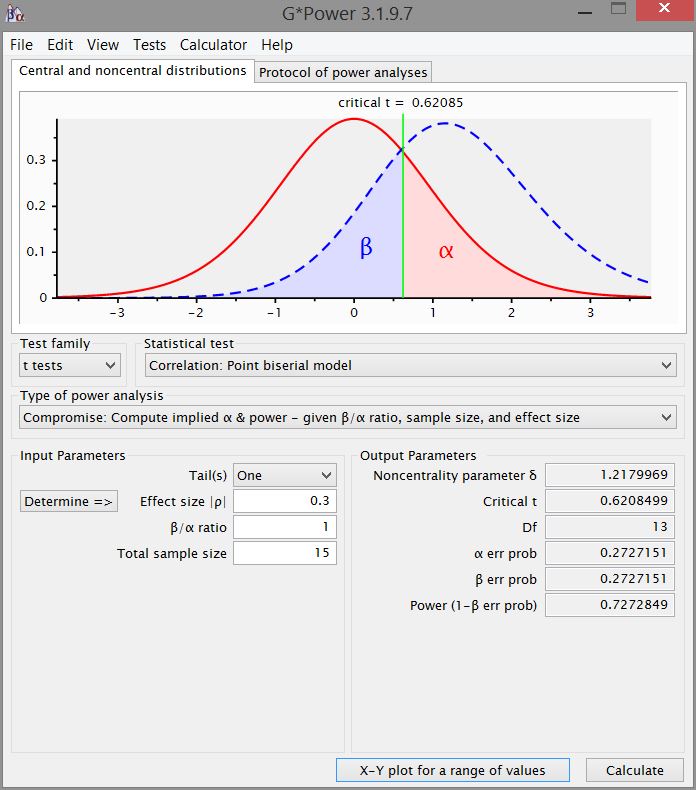
A single tail paired t-test conducted through the Statcrunch website was utilized to analyze the data, it was conducted two ways. The original format for RPM was used first, then modified for the second run to see if the results were significantly changed. The reason for this is because of the large numbers associated with the RPM as they were in the hundreds of millions whereas certificate issuances per year are only in the thousands. Truncating the digits on the RPM would attempt to normalize the results without altering the data. The results were better than expected, including the G*power output which had a power of 0.727, see figure 1 in the appendix for those results. Although below the 0.80 threshold, it is still statistically significant to show a correlation between the two variables. In addition, a correlation test was conducted through Statcrunch which verified the results.
Results
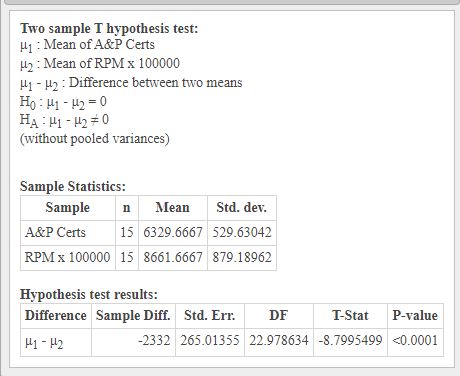
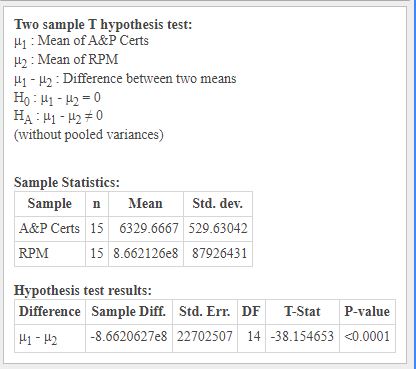
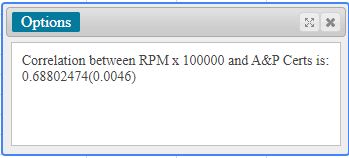
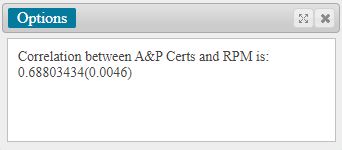
The results of the test were not unexpected but the strength of the results was surprising as the p-value was very low, according to Statcrunch it was <0.0001, for both tests ran, see figures 2 and 3 in the appendix. This makes them statistically significant, in addition to the t-test, a correlation test was conducted, it determined that the correlation between the two sets of data was 0.688 with a p-value of 0.0046. It was run for both the truncated RPM value and the complete number and the results were the almost identical in the correlation value whereas the p-value was the same, see figures 4 and 5 in the appendix. The results show there is a strong correlation between RPM and the issuance of original A&P certificates.
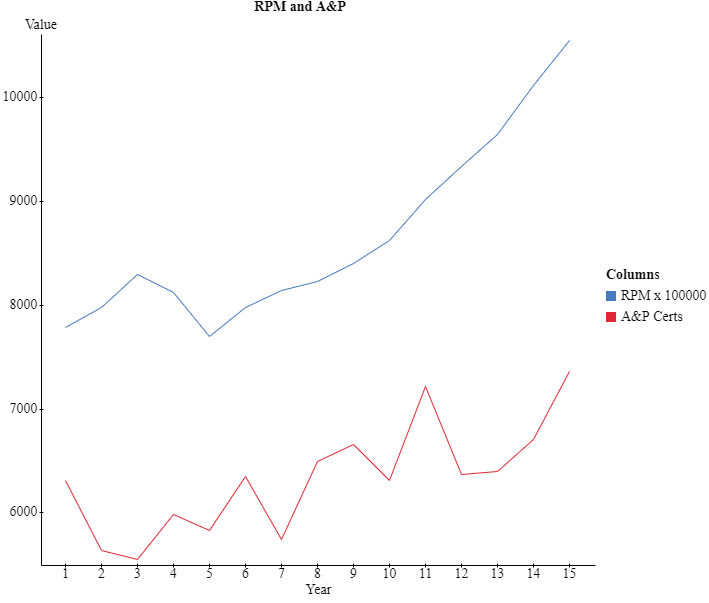
The research also revealed a definite lead-lag effect between the two factors, in figure 6, the year end totals are graphed, year one is 2004 and year 15 is 2018. For example, the 2008 housing crash affected the entire U.S. economy, but RPM started to decline in 2007, subsequently the A&P certifications declined the next year, see figure 6 in the appendix. This appears to show a strong correlation between the two data sets. Although it is statistically significant, economic factors may play a role in the results. For example, 2019 and 2020 were not included because of the drop in air traffic due to the COVID 19 pandemic. These results will have to be included in a future test to see if the hypothesis still is relevant and the lead-lag effect holds true.
Conclusion
The results of the tests indicate a strong correlation between both RPM and original A&P certificates, whether this is also caused by the wages and current economic conditions will have to be investigated with further research. Because of the this the null hypothesis is rejected and the alternate accepted. It appears from the results that the U.S. domestic airlines and their RPM show a strong correlation to the supply of new original mechanic certificate holders. A direct cause and effect relationship have not been tested but the evidence is strong to suggest further research in this area. It also appears that that prevailing economic conditions are also a factor for those pursuing the certification as the training time is significant. This can be correlated by the drop in RPM on one year and the subsequent drop in A&P certificates the following years. As flying increases, and economies improve, so do the issuance of certificates.
This research is not conclusive, but it should continue and expand using available data after the post COVID 19 pandemic RPM and A&P certificate issuance numbers are released by both the BTS and FAA. Furthermore, total employment numbers of certificated mechanics should also be factored into the equation if available to account for retirements or those leaving the trade for other more lucrative positions. Any skilled trade requires a significant time investment for training, more so for aircraft mechanics, correlating RPM and mechanics certificates could allow airlines to plan for recruitment of maintenance personnel much like they do for pilots. Perhaps those interested in a career in aircraft maintenance will be able to more accurately plan the timing of their training based on airline activity to ensure the best employment opportunities.
References
Bureau of Tranportation Statistics. (2020, December 11). Bureau of Tranportation Statistics. Retrieved from Post-CARES Act: U.S. Passenger Airlines Drop Nearly 37,000 Jobs in October 2020 from September: https://www.bts.gov/newsroom/post-cares-act-us-passenger-airlines-drop-nearly-37000-jobs-october-2020-september
Bureau of Transportation Statistics. (n.d.). Bureau of Transportation Statistics. Retrieved from Revenue Passenger Miles: https://www.transtats.bts.gov/Data_Elements.aspx?Data=3
Dalkilic, S. (2017). Improving aircraft safety and reliability by aircraft maintenance technician training. Engineering Failure Analysis, 687-694. doi:10.1016/j.engfailanal.2017.06.008
Federal Aviation Administration. (2020, April 22). Federal Aviation Administration. Retrieved from U.S. Civil Airment Statistics: https://www.faa.gov/data_research/ aviation _data _statistics/civil_airmen_statistics/#:~:text=The%20U.S.%20Civil%20Airmen%20Statistics,other%20government%20agencies%2C%20and%20industry.&text=Airmen%20who%20must%20have%20a,flight%20navigators%2C%20and%20flig
Kalemba, N. C.-P. (2019). Safety and the economic and financial performance in the airline industry: Is there any relationship? Aviation (Vilnius, Lithuania), 23(1), 7-14. doi:10.3846/aviation.2019.9744
Numanoğlu, M. F. (2020). Analysis of the periodic maintenance costs of aircraft fleet. Journal of International Trade Logistics and Law. Retrieved from https://search-proquest-com.ezproxy.libproxy.db.erau.edu/docview/2411169154?pq-origsite=summon
Olaganathan, R. M. (2020). Managing safety risks in airline maintenance outsourcing. International Journal of Aviation, Aeronautics, and Aerospace, 7(1). doi:10.15394/ijaaa.2020.1435
U.S. Bureau of Labor Statistics. (2020, September 1). U.S. Bureau of Labor Satistics. Retrieved from Aircraft and Avionics Equipment Mechanics and Technicians: https://www.bls.gov/ooh/installation-maintenance-and-repair/aircraft-and-avionics-equipment-mechanics-and-technicians.htm#tab-1

 Patrick Carroll